
Game Theory and Prisoner’s Dilemma: What We Call Making Friends with Enemy Agents for Mutual Payoff
Ever found yourself sitting across from someone you absolutely cannot stand, realizing you need their help to pull off a win? Welcome to my world. After a decade of dissecting strategic behavior, analyzing corporate power plays, and working through complex negotiation models, I can tell you one thing for certain. Pure conflict is a sucker's game. The real masterstroke lies in understanding game theory and prisoner's dilemma dynamics to turn a hostile rival into a temporary, high-value partner.
Look—it feels completely counterintuitive. Your gut screams at you to burn the bridge, double-cross the competition, or hoard your resources. But if you want the highest possible payout, brute force usually fails. Strategic cooperation is where the real money is made.
Let's break down what actually happens when adversaries choose to collaborate instead of destroying each other. It is not about world peace or singing round the campfire. It is cold, calculated self-interest.
Honestly? It is the closest thing to a real-world superpower we have.
The Foundations of Strategic Rivalry and Mutual Benefit
To understand why enemies form alliances, we have to look back at the classic math behind conflict. The foundational framework relies on analyzing options, payoffs, and predictable human paranoia. When two opposing entities interact, their choices dictate the ultimate outcome for both sides.
Think about classic corporate wars. Two tech giants spending billions suing each other over patents while a nimble startup steals their market share. Sounds familiar? That is what happens when organizations fail to grasp the mechanics of making friends with enemy agents for mutual payoff. Instead of wasting capital on endless friction, smart operators find the overlap in their Venn diagrams.
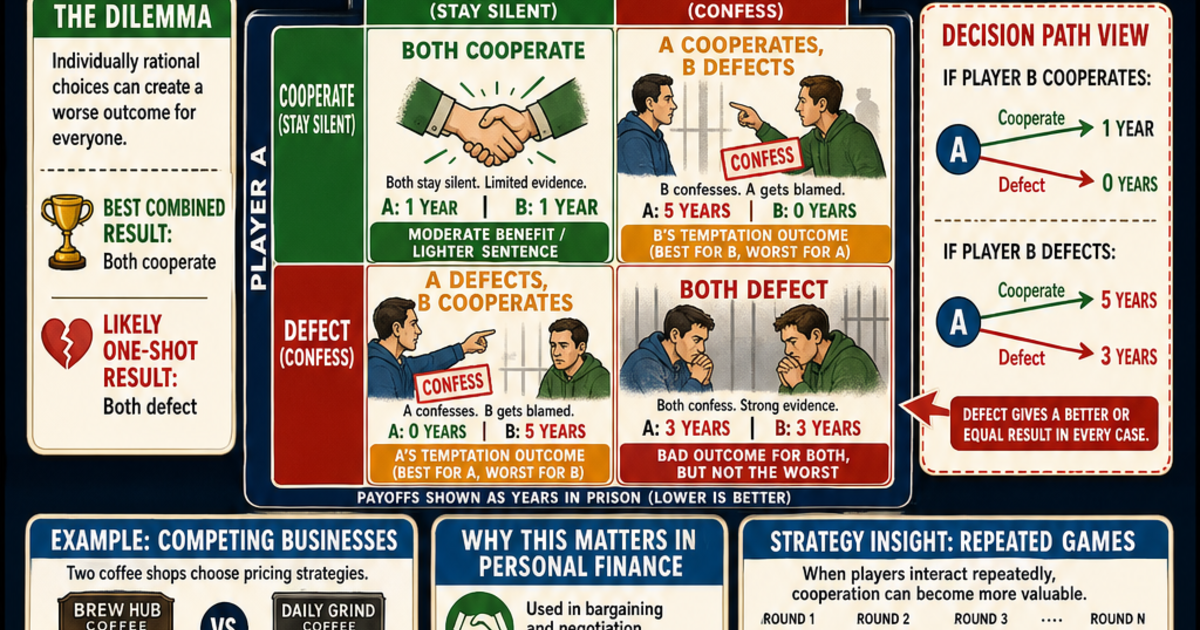
In traditional setups, the mathematical incentive to defect is massive. You want to protect yourself from getting burned, right? Naturally. But when both players default to self-defense, everyone leaves money on the table. Breaking that cycle requires a fundamental shift in perspective.
It boils down to a simple reality: your worst enemy might just be your most lucrative collaborator under the right market conditions.
The Anatomy of the Classic Matrix
The standard model pits two players against each other in a high-stakes choice: cooperate or defect. If both stay silent and work together, they get a decent result. If one sells out the other, the traitor gets off scot-free while the victim takes the full hit. But if both defect? They both get crushed.
That tension drives every high-stakes negotiation. It creates an environment ripe with anxiety where mistrust costs actual capital. You are constantly asking yourself whether the other party is setting a trap.
Understanding this balance is step one. Once you map out the incentives, the irrational behavior of your competitors suddenly makes complete sense.
Breaking the Defection Trap
How do you break out of that defensive death spiral? You change the rules. You stop looking at the interaction as a single, isolated event and start treating it as a long-term campaign.
When players realize they have to deal with each other tomorrow, next week, and next year, defection loses its charm. The penalty for betrayal skyrockets over time. Suddenly, reaching out an olive branch to a hostile competitor becomes the most rational move on the board.
It takes guts. I have seen seasoned executives sweat through their suits at the mere suggestion of sharing operational risk with a direct rival.
Iterated Interactions: Why Time Changes Everything
Everything changes when you repeat the game. A single interaction rewards betrayal, but repeated encounters reward consistency and calculated trust. This transition turns cutthroat strategic rivalries into sustainable partnerships.
In the trade, we call this the Shadow of the Future. If the future is long enough, the short-term temptation to screw over your opponent vanishes. You start building what researchers call iterated prisoner's dilemma strategies, where long-term gains far outweigh immediate payouts.
I remember consulting for two logistics firms fighting over the same regional routes. They were undercutting each other into bankruptcy. We forced them to the table to co-load freight on low-density runs. They hated each other's guts, but their margins jumped by thirty percent in six months.
Cooperation isn't about liking the person across the table. It is about respecting their capacity to ruin your afternoon if you step out of line.
The Power of Tit-for-Tat Mechanisms
The most famous, effective strategy for long-term collaboration is laughably simple: Tit-for-Tat. You start by offering cooperation. If the opponent cooperates back, you keep doing it. If they defect, you immediately hit them back with a defection on the very next round.
It works because it is clear. It is predictable. Your rival doesn't have to guess what you are doing.
By pairing clarity with immediate retaliation, you teach your competitor that pulling a fast one costs more than it earns. They fall in line, not out of love, but out of basic math.
Enforcing Stability Through Credible Threats
You cannot have peaceful collaboration without a big stick hidden behind your back. Friendly gestures mean zero if your adversary thinks you are soft.
To make an alliance with an enemy stick, you must maintain a credible threat of retaliation. They need to know that while you prefer mutual profitability, you are fully prepared to burn down the shed if they betray the deal.
That balance keeps the peace. It creates a stable, self-enforcing contract between hostile parties without needing an army of lawyers to babysit every interaction.
Real-World Co-opetition: From Business Coalitions to Geopolitics
Out in the wild, we call this phenomenon "co-opetition." It happens every day right under your nose. Apple buys OLED displays from Samsung despite suing them in courts across three continents. Competitors share infrastructure, pool research costs, and set industry standards together.
Why? Because fighting over every single breadcrumb leaves you starving. Smart operators leverage Nash equilibrium co-opetition to expand the whole pie before fighting over how to slice it up.
If you look at historical alliances, the strongest ones were never forged in friendship. They were forged in shared desperation against a bigger, meaner threat.
When you align incentives properly, yesterday's arch-nemesis becomes today's essential ally.
Setting Up Win-Win Frameworks
Building a workable deal with an enemy requires strict containment. You don't open up your entire playbook. You isolate a specific project where both sides gain an massive edge by pooling resources.
Here is a bullet-proof checklist for structuring these volatile alliances:
- Define clear boundaries: Keep the joint project strictly separated from your core competitive advantages.
- Ensure symmetric risk: Both sides must stand to lose an equal amount if the partnership collapses.
- Establish transparent metrics: Use third-party data so neither side can cheat without getting caught immediately.
- Maintain independent capabilities: Never let your partner hold the sole key to your operational survival.
Follow those rules, and you can comfortably sleep in the same tent as your rival without worrying about getting stabbed in your sleep.
Managing the Paranoia Factor
The biggest hurdle to these deals isn't the technical paperwork; it is the sheer paranoia. Human psychology is hardwired to assume bad intentions from recognized adversaries.
Overcoming that bias requires micro-steps. You don't jump straight into a multi-billion-dollar joint venture. You start with tiny, low-stakes exchanges to test their compliance.
Slowly, predictably, the feedback loop settles down. Paranoia gives way to calculated confidence.
Common Questions About Game Theory and Prisoner's Dilemma
What is the core lesson of the Prisoner's Dilemma?
The primary lesson is that individual rationality can lead to collective irrationality. When two parties act strictly in their own short-term self-interest without communication or trust, they end up with a worse outcome than if they had compromised and cooperated.
How can enemies build trust without risking complete betrayal?
Trust isn't required; structural verification is. Enemies build successful alliances by starting with small, low-risk exchanges, utilizing clear "tit-for-tat" feedback mechanisms, and creating contractual or operational penalties that make betrayal financially painful for the defecting party.
Why do rational actors choose to defect in a single-round game?
In a single-round game without future consequences, defecting is the strictly dominant strategy. It guarantees that you protect yourself from the worst possible outcome (being betrayed while cooperating) while opening up the chance to get the highest individual payout if the other player tries to cooperate.