
Tesla Insurance Telemetry Metrics: How Real-Time G-Force, Braking, and Forward Collision Warnings Calculate Safety Scores
Ever had a computer judge your driving while you are just trying to grab a late-night taco run? Welcome to the wild world of Tesla Insurance Telemetry Metrics. If you drive a Tesla and opted into their proprietary insurance program, your car is essentially a four-wheeled data analyst that never sleeps. It tracks every turn, every sudden stop, and every millimeter of distance between your bumper and the guy in front of you. Honestly? It is equal parts fascinating and downright nerve-wracking.
Traditional insurance companies look at your age, credit score, zip code, and maybe your driving record from three years ago to figure out your rates. Tesla flipped that model on its head. They do not care how old you are or where you live as much as they care about what you are doing with your feet and hands right now. By tapping directly into the car's internal sensor suite, Tesla monitors your real-time behavior to generate a daily Tesla Safety Score. This dynamic score dictates your monthly premium down to the exact cent.
Look—the tech is undeniably cool, but it comes with a steep learning curve. One sharp left turn or a overly cautious automated warning can send your daily score plummeting, causing your monthly rate to spike. Understanding how these algorithmically driven vehicle telemetry data points work is the only way to keep your hard-earned cash in your wallet instead of handing it over to the mothership. Let us break down the exact math, mechanics, and quirks behind the sensors keeping tabs on you.
In this guide, we are going to dive deep into the specific raw metrics Tesla extracts from your vehicle network. We will look at how high-frequency g-force measurements, micro-braking events, and camera vision algorithms blend together to evaluate your collision risk. Whether you are trying to fix a tanking score or just curious about the underlying math, consider this your masterclass in beating the telemetry system at its own game.
The Mechanics of Real-Time Vehicle Telemetry Data
Inside the Sensor Array: From Inertial Measurement Units to Vision Systems
Your Tesla is practically a rolling supercomputer crammed full of high-precision hardware. At the heart of the Tesla Insurance Telemetry Metrics engine is the Inertial Measurement Unit, or IMU. This tiny silicon chip measures linear acceleration along three axes alongside rotational rates. The IMU checks in hundreds of times per second, detecting microscopic changes in speed and angle long before you even feel them in the seat of your pants. Combined with wheel-speed sensors and steering angle encoders, the car knows instantly if you are cruising smoothly or throwing the vehicle around like a track car.
Then, of course, there is Tesla Vision. Unlike legacy automotive tracking dongles that plug into an OBD-II port and only measure basic acceleration, Tesla utilizes its suite of exterior cameras. These optical sensors feed real-time video to the onboard autopilot computer, processing surroundings to measure spatial distance between you and moving objects. It is not just tracking what your vehicle does in a vacuum. The system actively correlates your physical movement with the environment around you, creating a multi-layered profile of your actual risk profile.
All of this raw data feeds directly into internal gateway modules over high-speed Controller Area Network (CAN) bus protocols. The vehicle aggregates these signals locally, processes them through embedded telemetry software, and periodically uploads condensed data payloads to Tesla's cloud servers via cellular connection. This seamless loop happens continuously while driving. It means your drive is scored almost immediately after you shift into Park.
Understanding the hardware architecture makes one thing abundantly clear: you cannot trick this system with soft pedals alone. The sensors capture absolute physical forces alongside relative spatial telemetry. If the car experiences a physical force exceeding predefined engineering thresholds, it logs that event regardless of your intentions. It is cold, hard physics meeting cloud computing.
How the Safety Score Algorithm Translates Raw Physics into Dollars
So, how does a sudden swerve turn into a higher monthly insurance bill? Tesla uses a mathematical formula based on predicted collision frequency. The system measures individual safety events per 1,000 miles driven. Each telemetry metric carries a specific statistical weight based on millions of miles of historical fleet accident data. In short, Tesla mapped out which driver behaviors directly correlate with real-world insurance claims, and they penalize those specific actions heavily.
The system calculates your overall real-time driving safety score on a 1-to-100 scale using a complex logarithmic equation. A score of 100 means you present virtually zero statistical likelihood of causing an accident based on their risk models. As your safety score drops, your predicted risk increases exponentially, which translates directly to higher monthly premium tiers. It is a hyper-dynamic pricing model that adjusts every single month based on a 30-day rolling average of your telemetry performance.
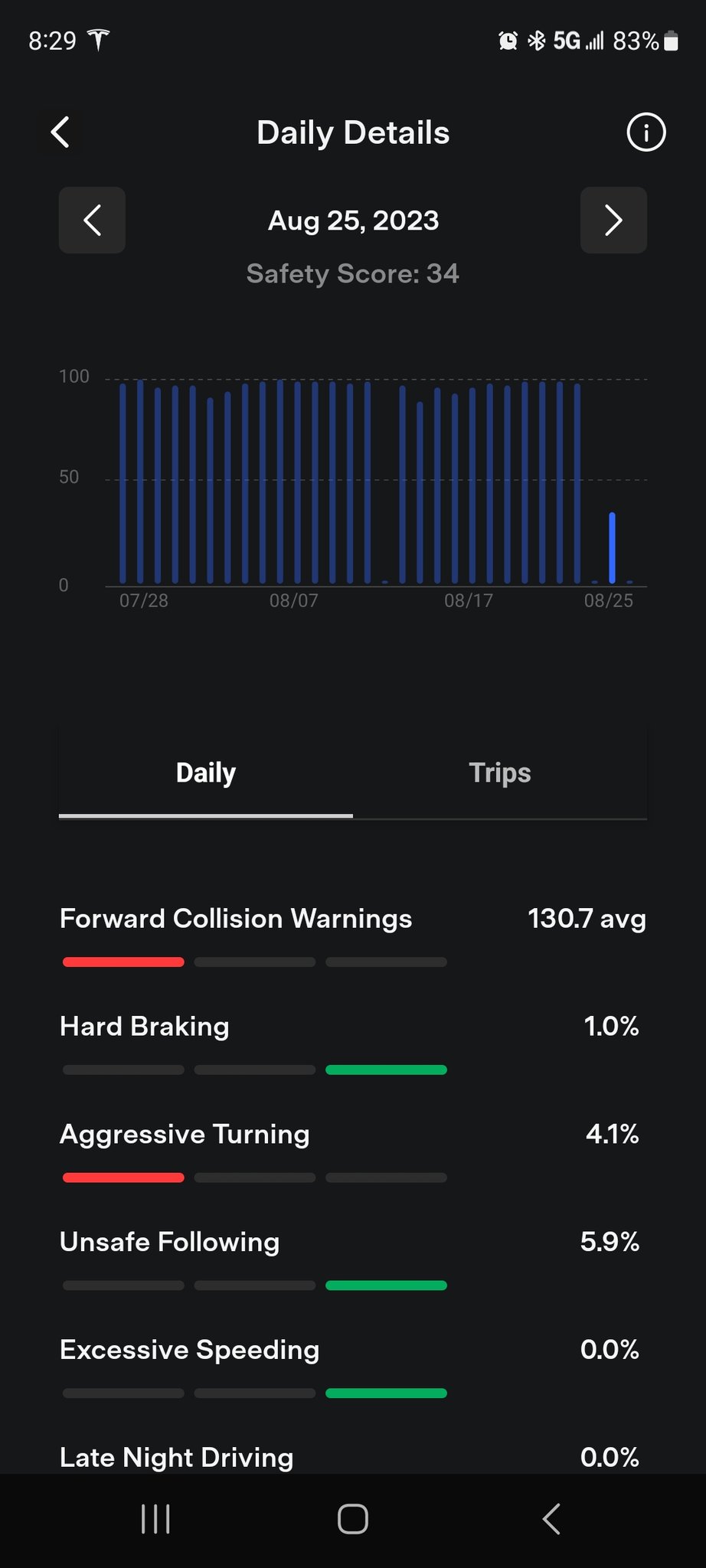
Here is a detailed breakdown of the main telemetry factors that feed directly into the scoring algorithm:
- Forward Collision Warnings (FCWs) per 1,000 Miles: Tracks visual and audible warnings triggered when the car detects a potential front-end impact.
- Hard Braking Frequency: Measures backward acceleration forces exceeding specific deceleration limits defined in gravitational units.
- Aggressive Turning G-Force: Calculates lateral forces generated when taking curves, roundabouts, or sharp turns too quickly.
- Unsafe Following Time: Monitors the proportion of time spent tailgating another vehicle at speeds above 50 mph.
- Forced Autopilot Disengagements: Logs instances where the Autopilot system turns off because you failed to keep your hands on the wheel.
- Late-Night Driving Hours: Measures the proportion of time spent driving between 11:00 PM and 4:00 AM, when severe accidents statistically spike.
The clever part—or frustrating part, depending on your perspective—is that these metrics are normalized against mileage. If you drive 10 miles and hit the brakes hard once, your daily score will take a massive hit because your event density per mile is high. However, if you hit the brakes hard once during a 300-mile highway road trip, the impact on your score is negligible. Distance is your best friend when diluting a single bad driving event.
Deconstructing the Primary Safety Score Metrics
Hard Braking and Lateral G-Force Acceleration Limits
Let us talk about G-forces. You do not need to be a fighter pilot to trigger an acceleration penalty in a Tesla. The threshold for hard braking telemetry metrics is set surprisingly low. Tesla defines hard braking as a deceleration force exceeding 0.4g, which translates to roughly 8.8 miles per hour per second. In plain English? If you step on the brake pedal with enough force to make your purse or groceries slide off the passenger seat, you just logged a strike on your score.
Lateral G-force, or aggressive turning, operates under a similar regime. The system flags turning events that exceed 0.4g of lateral force in either direction. Think about taking an off-ramp a little too hot or whipping through a neighborhood roundabout without slowing down first. The IMU measures the sideways pull on the chassis. Even if you feel completely in control and the tires are nowhere near squealing, the computer registers that 0.4g threshold and ding goes your metric score. It encourages extremely smooth, predictable inputs.
The trickiest part about hard braking is handling yellow light dilemmas and unpredictable traffic. If a traffic signal turns yellow and you stop firmly to avoid blowing through an intersection, the telemetry system penalizes your safety score for hard braking. Conversely, if you coast through, you risk a red-light camera or an actual traffic citation. It places the driver in a bizarre position where defensive, sudden stopping is categorized as risky behavior by the algorithm.
To avoid triggering these G-force penalties, master the art of regenerative braking. Relying on the car's natural electric motor drag rather than slamming your foot on the friction brake pedal keeps your deceleration well under the 0.4g limit. Anticipate stops hundreds of feet in advance. By letting your foot off the accelerator early, you allow the battery to capture kinetic energy smoothly while keeping your hard braking events at a pristine zero count.
Forward Collision Warnings and Spatial Distance Algorithms
Of all the telemetry metrics, Forward Collision Warnings (FCWs) cause drivers the most headaches. An FCW occurs when the car's vision system determines that an impact is imminent based on your current speed, vector, and the speed of the vehicle ahead. The car outputs a high-pitched audible beep and flashes a red alert on the display screen. Every time this happens while you are manually driving, it gets uploaded into your risk profile as a high-weight safety violation.
The math behind spatial distance monitoring relies on time-to-collision (TTC) calculations. The computer constantly divides the distance between your front bumper and the lead vehicle by the relative closing speed. If the TTC drops below a critical safety window, the FCW fires off. The catch? The system sets the telemetry baseline to high-sensitivity mode for score calculations regardless of what sound setting you select on the touchscreen menu. You can turn the warning sound down or off, but the system still records the event in the background.
The algorithm also aggressively penalizes tailgating through the "Unsafe Following Time" metric. This specifically tracks driving above 50 mph where your space cushion drops below 3 seconds. The car categorizes following distance into two buckets: under 1 second (severe risk) and between 1 and 2 seconds (moderate risk). If you spend a significant portion of your highway commute drafting behind semi-trucks or tailgating slow drivers in the passing lane, expect your predictive vehicle risk score to plummet.
The most common cause of false-positive FCWs involves parked cars along curved roads. As you round a turn, the camera system might briefly project your trajectory straight into a car parked legally on the curb, triggering a frantic warning beep. While Tesla continuously refines its vision neural networks to eliminate these phantom alerts, they still occur. The best defense is giving parked cars on bends a wide berth and taking manual control with extra caution in tight urban corridors.
Strategies to Optimize Your Telemetry Data and Lower Premiums
Navigating Autopilot Usage and Late-Night Telemetry Windows
Here is a major shortcut that many Tesla owners overlook: miles driven on Autopilot or Full Self-Driving (FSD) are completely exempt from most safety score penalties. When Autopilot is engaged, the car takes legal and statistical responsibility for its own driving physics. If the car brakes hard or takes a curve aggressively while Autopilot is driving, it does NOT count against your human driving metrics. However, you must remain vigilant to prevent forced disengagements.
If you ignore the steering wheel nags or fail to pay attention, Autopilot will disengage for the remainder of your drive after giving visual and audio warnings. A forced Autopilot disengagement is arguably the worst single strike you can get on your scoring record. It serves as an immediate indicator of driver distraction in Tesla's risk model. Use Autopilot frequently to smooth out your highway miles, but always keep your hands on the wheel and your eyes on the road to keep the system happy.
Another major lever in optimizing your score is controlling your driving hours. Tesla added late-night driving metrics to their algorithm because statistics show that night driving carries significantly higher accident rates due to fatigue, reduced visibility, and intoxicated drivers on the road. The system tracks the percentage of your total driving that occurs between 11:00 PM and 4:00 AM. Even if you drive like an absolute saint during those hours, the simple act of being on the road late at night automatically drags down your daily safety score.
To maximize your monthly premium savings, follow these proven tactical steps to protect your telemetry metrics:
- Maximize Regenerative Braking: Lift off the accelerator early to allow smooth, automated deceleration without touching the friction brake pedal.
- Increase Following Distances: Maintain at least a 3-to-4 second gap behind lead vehicles, especially when traveling over 50 mph.
- Leverage Autopilot on Highways: Engage Autopilot during routine freeway commuting to accumulate penalty-free miles and dilute prior safety strikes.
- Avoid the 11 PM to 4 AM Window: Minimize nighttime trips whenever possible to prevent mandatory late-night driving deductions.
- Take Curves Gently: Slow down significantly before entering turns or roundabouts to keep lateral G-forces safely below the 0.4g limit.
By treating driving as a game of smooth inputs, you can comfortably maintain a score above 95. That small effort translates directly into massive discount percentages on your monthly policy renewals.
Common Questions About Tesla Insurance Telemetry Metrics
What is considered a good Tesla Safety Score for lower insurance rates?
Generally, a score of 95 or higher yields substantial premium discounts compared to traditional auto insurance policies. Drivers with scores between 98 and 100 receive the maximum possible savings tier, often cutting their insurance costs by 20% to 40% depending on the state and baseline rates.
Does hard braking count against my score if Autopilot is turned on?
No. Hard braking, aggressive turning, and unsafe following events that occur while Autopilot or Full Self-Driving (FSD) is actively engaged are excluded from your human driving safety score. However, if the system disengages forcefully due to driver inattention, that disengagement will severely penalize your score.
Can I reset my Tesla Safety Score if it drops significantly?
You cannot manually reset your safety score history with a button push. The system operates on a 30-day rolling average basis, meaning older driving data naturally drops off as time passes. The fastest way to dilute a bad score is to drive long distances safely over the following days to increase your total mile count.
Why did I get a Forward Collision Warning when there was no car in front of me?
False forward collision warnings are typically caused by environmental factors like parked cars along sharp curves, sudden glares on the camera lenses, or overhead street signs that the vision system briefly misinterprets as obstacles. Maintaining camera cleanlines can help reduce phantom warnings.
Mastering the intricacies of real-time driving data allows you to turn your vehicle's advanced technology into a financial asset rather than an unpredictable expense.