
Thermionic Emission Mechanics: Sustaining an Electric Current in Vacuum Using High Voltage Cathodes
Ever wondered how we managed to manipulate electrons long before silicon microchips took over the world? Back in the day, if you wanted to amplify a radio signal, render an image on a giant television box, or run a high-power radar system, you had to boil electrons right out of solid matter. Welcome to the fascinating, glowing world of thermionic emission mechanics. It is old-school physics, sure, but it is the backbone of high-power vacuum electronics that still keep critical infrastructure running today.
Look, the idea of pulling a current out of thin air—or rather, out of a complete vacuum—sounds like pure wizardry until you dive into the thermodynamics. You heat a metal up until it glows red hot, slap a massive positive voltage across a gap, and boom. You have got a stream of free electrons flying through space. But keeping that stream steady without blowing up your hardware? That is where the real engineering nightmare begins.
I have spent over a decade messing around with high-voltage physical systems, and trust me, vac-tubes and electron guns will humble you quickly. One minor thermal calculation mistake, and your expensive custom cathode turns into a puddle of melted tungsten. Let us break down how thermionic emission mechanics actually works when you push high voltages into empty space.
Honestly, it all comes down to giving electrons enough kinetic energy to break free from their atomic cages. Think of it like a crowded concert where the heat turns up so high that people start jumping over the perimeter fence. The fence, in this analogy, is what physicists call the work function.
The Physics of Freeing Electrons: Work Functions and Heat
Overcoming the Energy Barrier
Inside any conductive metal, electrons roam around in a sort of Fermi sea. They are free to move within the metal, but they cannot easily escape its surface because of an attractive electrostatic force. This energy threshold is the work function, usually measured in electron-volts. To get an electron out, you must inject thermal energy. As the temperature rises, the thermal agitation gives a tiny fraction of those electrons enough momentum to overcome that surface barrier.
When you heat a cathode, you are basically shifting the energy distribution of its electron gas. Most electrons stay trapped, but the high-energy tail of the Fermi-Dirac distribution spills over the edge. It is a statistical game. Higher temperatures mean a larger tail, which directly translates to a higher potential current density escaping into the vacuum void.
Now, you cannot just use any random metal for this job. If you try using copper, it will melt long before it reaches a temperature capable of kicking out a useful number of electrons. That is why materials like tungsten, thoriated tungsten, and lanthanum hexaboride are the undisputed kings of the cathode realm. They possess high melting points combined with manageable work functions.
The Richardson-Dushman Equation in Practice
If you want to quantify this phenomenon, you have to turn to the famous Richardson-Dushman equation. It calculates the current density based purely on the cathode's absolute temperature and its material-specific work function. The math shows an exponential relationship. A tiny bump in heater temperature results in a massive surge of emitted electrons.
In real-world applications, this exponential curve is both a blessing and a curse. You get insane current output from small surface areas, but thermal control becomes an absolute nightmare. A tiny fluctuation in your filament voltage can swing your emission current wildly. Engineering a stable power supply for these systems requires rock-solid current regulation, not just simple voltage control.
Furthermore, real metal surfaces are not perfectly smooth quantum planes. They have microscopic grain boundaries, impurities, and crystal orientations, all of which alter the local work function. That means emission never happens uniformly across the surface; it pops off in tiny microscopic hot spots that can cause localized pitting over time.
Thermal Stress and Cathode Degradation
Operating a cathode at temperatures exceeding 2000 degrees Kelvin takes a massive toll on the structural integrity of the material. Thermal expansion causes physical warping, which changes the critical gap spacing between your anode and cathode. In high-precision electron optics, a shift of just a few micrometers can completely ruin your beam focus.
Evaporative loss is another silent killer in these systems. At extreme temperatures, the cathode material slow-cooks itself out of existence. Tungsten atoms literally evaporate off the filament and deposit themselves on the cooler inner walls of the vacuum chamber. This thins the filament, raising its electrical resistance, which makes it run even hotter until it eventually snaps.
To combat this, engineers developed oxide-coated cathodes, which use layers of barium or strontium oxide. These coatings drastically lower the work function, allowing heavy thermionic emission mechanics to occur at much lower operating temperatures. The trade-off? They are absurdly delicate and will poison instantly if your vacuum pressure degrades even a tiny bit.
High Voltage Cathodes and the Space Charge Problem
Building the Potential Gradient
So, you have managed to boil electrons off your cathode. Now what? Without an external force, those electrons just hover near the surface like a dense cloud of midges, forming what is known as a space charge. Because like charges repel, this cloud creates its own negative electrostatic field that pushes newly emitted electrons right back into the cathode surface.
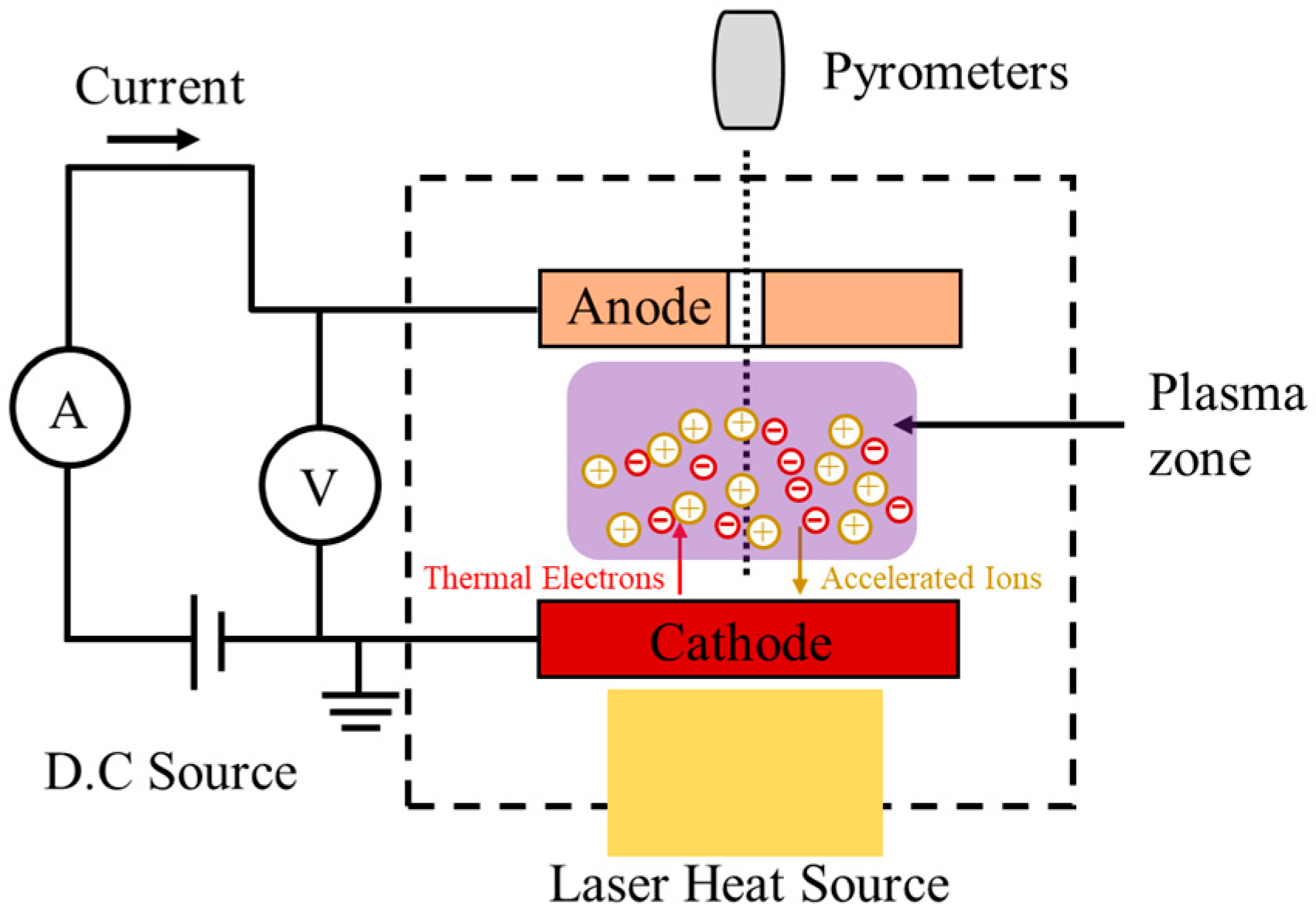
Enter the high voltage cathode assembly. By placing a strongly positive anode opposite your cathode, you establish an intense electrostatic field across the vacuum gap. This potential gradient grabs those hovering electrons and accelerates them across the vacuum at incredible speeds, transforming a static cloud into a directed, continuous electric current.
The magnitude of this voltage must be high enough to sweep electrons away faster than they are emitted if you want to reach peak efficiency. We are talking kilovolts to megavolts depending on the scale of the device. At these levels, the kinetic energy transferred to the electrons is immense, requiring robust electrical insulation and clever geometry to prevent unwanted arc discharges.
Navigating the Child-Langmuir Law
When you ramp up the voltage, you quickly encounter the space-charge-limited regime. In this state, the current flow is no longer limited by how hot the cathode is, but rather by how fast the anode voltage can pull electrons out of the space charge cloud. This relationship is governed by the Child-Langmuir Law, often referred to as the three-halves power law.
Understanding this transition is essential for designing vacuum equipment. If your system operates in the space-charge regime, increasing the filament heat does absolutely nothing to increase your current. You are capped by the electrostatic geometry of your system. You have to crank up the high voltage to draw more current through the vacuum gap.
Here is a summary of how different operating regimes control electron flow within a vacuum environment:
- Temperature-Limited Regime: Current is entirely dependent on cathode heating; high voltage sweeps all available electrons away instantly.
- Space-Charge-Limited Regime: Current is choked by the electron cloud's negative charge; governed tightly by the 3/2 power of the anode voltage.
- Breakdown Regime: Voltage exceeds the dielectric limit of the physical geometry, causing destructive vacuum arcs.
Mitigating Vacuum Arc Flashovers
High voltage in a vacuum sounds like a perfect insulator, right? Wrong. Vacuum breakdown is a real, destructive phenomenon. If your electric field strength gets too high at sharp metallic points, field emission takes over. Microscopic whiskers on the cathode surface concentrate the electric field, pulling electrons out cold and vaporizing the tip in a micro-explosion.
Once metal vapor enters the vacuum gap, it ionizes instantly. That pristine, non-conductive vacuum collapses into a roaring, low-resistance plasma arc that can vaporize your high-voltage power supply in milliseconds. Preventative measures require polished, mirror-finish electrodes with generous, smooth radii to eliminate high-field points.
Proper conditioning processes are also mandatory for new high-voltage cathodes. Engineers slowly ramp up the voltage in small increments, deliberately burning off microscopic surface burrs in controlled, low-energy micro-discharges before running the system at full rated power.
Maintaining Vacuum Stability and Current Continuity
Vacuum Quality and Molecular Mean Free Path
To sustain a clean electric current in vacuum, the space between the electrodes must be as empty as humanly possible. We measure this quality using the mean free path, which is the average distance an electron travels before colliding with a residual gas molecule. If your vacuum pressure is too high, electrons crash into gas atoms, knocking off extra electrons and creating positive ions.
Those positive ions pose a massive threat. Accelerated by the high voltage, they fly backward and slam directly into the delicate cathode surface. This process, known as ion bombardment, literally sandblasts the cathode at an atomic level, rapidly destroying low-work-function coatings and causing catastrophic emission failure.
To keep high-voltage vacuum systems healthy, ultra-high vacuum levels are mandatory. You are looking at pressures below $10^{-6}$ Torr, often requiring a combination of turbomolecular pumps, ion pumps, and getter materials to trap lingering hydrogen and oxygen molecules.
Beam Focusing and Magnetic Steering
Electrons all carry a negative charge, which means a dense beam wants to blow itself apart due to mutual electrostatic repulsion. As the electron beam travels from the cathode toward the target, this space-charge blow-up rapidly spreads the beam out, reducing its current density and power precision.
To counteract this, specialized magnetic and electrostatic lenses are wrapped around the vacuum channel. External magnetic fields apply a Lorentz force to the moving electrons, squeezing the beam back into a tight, controlled line. It is similar to focusing light with glass optics, except you are bending high-energy particle trajectories with magnetic fields.
Proper beam shaping requires a delicate balance. Here are the core mechanical steps involved in steering and sustaining an accelerated electron beam:
- Thermal Generation: Heating the cathode filament to release free electrons via thermionic emission.
- Initial Extraction: Using a biased grid or Pierce electrode geometry to shape the nascent electron cloud.
- Primary Acceleration: Applying high differential potential to pull electrons across the primary vacuum gap.
- Magnetic Collimation: Utilizing external solenoid coils to constrain lateral space-charge expansion.
- Target Collector Impact: Dissipating the kinetic energy of the electrons cleanly at the high-power anode target.
Anode Thermal Management
What happens when a high-voltage electron beam hits the anode? All that kinetic energy turns instantly into heat and X-rays. If you are running a megawatt-level electron beam welder or high-power X-ray tube, the power density at the anode can easily melt solid tungsten in a heartbeat.
Cooling the anode requires insane fluid dynamics. Rotating anodes are commonly used in medical X-ray systems to constantly spread the heat load over a larger spinning ring of metal. Industrial vacuum devices use high-flow, pressurized water-cooling channels machined directly into the back of the oxygen-free copper anode blocks.
If the anode overheats to the point of outgassing, those liberated gas molecules drift back into the high-voltage region, initiating the vacuum arcs we discussed earlier. Thermal management of the anode is just as critical to current stability as the heater control on the cathode itself.
Common Questions About Thermionic Emission Mechanics
What is the difference between thermionic emission and field emission?
Thermionic emission relies primarily on high thermal energy to boost electrons over the material work function barrier. Field emission, on the other hand, uses extremely high localized electric fields to physically tunnel electrons through the barrier without requiring high temperatures.
Why is a ultra-high vacuum necessary for high voltage cathodes?
A vacuum prevents electrons from colliding with gas molecules, which would create plasma arcs, lose beam energy, and generate positive ions that physically destroy the cathode through high-energy bombardment.
What materials make the best high voltage thermionic cathodes?
Tungsten, thoriated tungsten, and Lanthanum Hexaboride are industry standards due to their combination of high melting points, mechanical strength, and relatively low work functions under continuous operation.
How does space charge affect current flow in a vacuum gap?
The space charge is a cloud of negative electrons hovering near the cathode that repels newly emitted electrons. It acts as an internal bottleneck, limiting the maximum achievable current unless the applied anode voltage is increased.